Modules
sciscripts.Analysis
Module for calculations, signal processing and plotting. Useful for general-purpose analysis, and specially useful for analyzing experiments recorded using the sciscripts.Exps module.
Submodules are higher-level functions implementing the lower-level functions at sciscripts.Analysis.Analysis.
sciscripts.Analysis.Stats
Functions and wrappers for several calculations. Specifically, the sciscripts.Analysis.Stats.Full function takes the data, a list of factors and some more data information, and apply the most appropriate effect and post-hoc test:

sciscripts.Exps
Module for preparing and running stimulation paradigms for several experiments. Depends on sciscripts.IO for generating signals and writing stimulus to data acquisition cards.
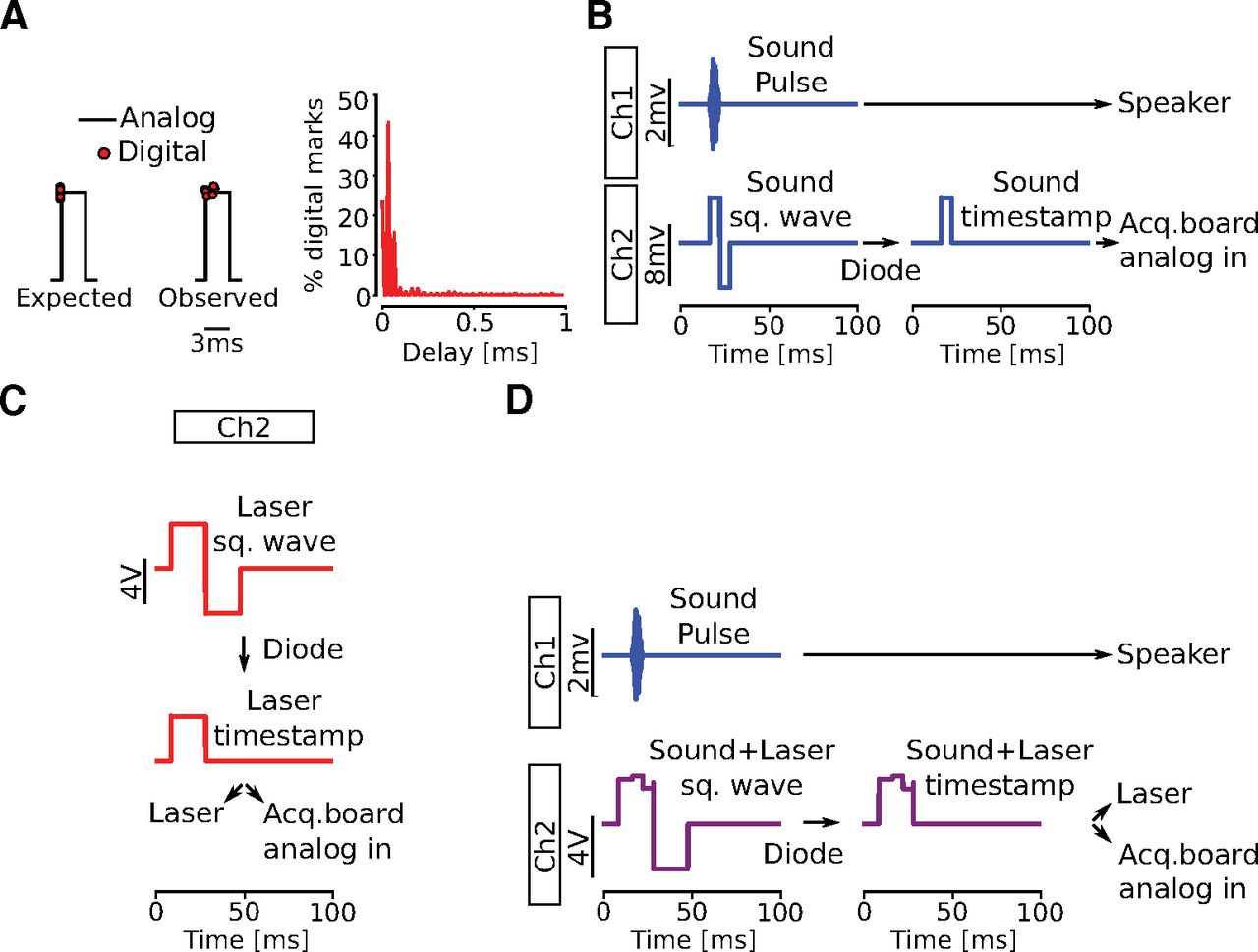
SciScripts can use a sound card to provide sound stimulation (d’oh!), but also to provide digital triggers (with a simple addition of a diode at the device’s input). This allows for, as example, providing combined sound and laser stimulation (see Examples/SoundAndLaserStimulation.py). Combined with a real-time kernel and a well setup sound system, you can achieve a very precise stimulation, at high sampling rates (192kHz in our system; see Malfatti et al., 2021, Figure 1):
sciscripts.IO
Module for generating signals, interface with input-output cards and reading/writing of several different file types.
Submodules are higher-level functions implementing the lower-level functions at sciscripts.IO.IO.